If you’re a healthcare professional preparing for multiple Prometric-based licensing exams, you’ve probably wondered whether a single well-chosen biochemistry resource can truly cover all your bases — or whether you need a separate book for each exam. The short answer is: yes, it is absolutely possible, provided you choose the right resource.
Why These Exams Test Biochemistry the Same Way
Gulf and Middle Eastern Prometric exams follow international clinical competency benchmarks. Because of this the biochemistry multiple choice questions in Biochemistry MCQs for DHA MOH HAAD Prometric Exams are very similar in level and question format to those in Biochemistry MCQs for SCFHS OMSB Prometric Exams.
Also these exams focus heavily on situations. They don’t just ask you to remember facts, about biochemistry. Instead they give you patient-centered cases that ask you to use your knowledge to diagnose, investigate and manage conditions. This means that if you train in MCQ-based reasoning for one exam you are also preparing yourself well for the others.
What a “Cross-Exam” Biochemistry Book Must Deliver
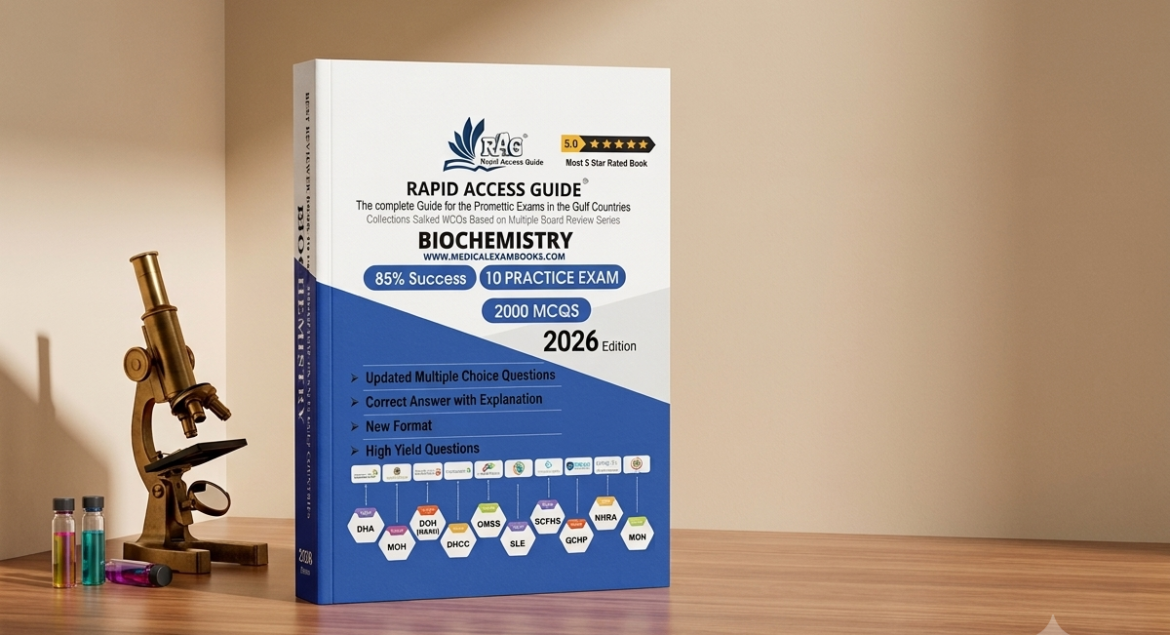
Naturally not every biochemistry book is good enough. To be a Biochemistry Book for KMLE QCHP NHRA Prometric Exams a book has to do more than just list facts. It should deliver MCQs in the same format and style as those encountered on the actual exam day. The explanations should go beyond simply providing the correct answer and help you develop clinical reasoning and think like a doctor. It should also highlight high-yield topics and concepts that repeatedly appear across different exams, so you know what to prioritize.
Also the content has to be updated so it matches the latest exam plans. Licensing groups do change their questions sometimes. So up-to-date information is just as important, as covering all the topics.
The Smart Study Strategy: One Book, Multiple Passes
When you have the resource the strategy becomes simple.
First do a pass of all MCQs without any time pressure and focus on understanding every explanation.Next do a pass where you simulate exam conditions and keep strict time limits.Finally on the pass, which you tailor to the specific upcoming exam focus on the question patterns and clinical scenarios that are most typical for that particular licensing body.
This approach works because even though exams have passing thresholds and regional clinical context the biochemistry MCQs still come from the same international knowledge base. Therefore mastering one set of well‑constructed MCQs gives you exam readiness that transfers, to exams.
Avoiding the “Multiple Books” Trap
Many candidates often make the mistake of buying resources for every exam they plan to sit. This choice causes content overlap wastes revision time and creates overload. Instead it is more efficient to invest deeply in one high-quality resource and add only brief exam-specific orientation notes.
Furthermore switching between books breaks the spaced‑repetition rhythm that is so crucial to biochemistry retention. Therefore staying consistent, with a comprehensive resource consistently outperforms the scattered multi‑book approach.
Frequently Asked Questions
Can one biochemistry MCQ book really cover DHA, MOH, and HAAD together?
Yes. Since all three exams use the Prometric platform and follow similar clinical MCQ patterns, a book specifically designed for Biochemistry MCQs for DHA MOH HAAD Prometric Exams will cover the shared question framework. You may, however, need brief supplementary notes on country-specific clinical guidelines.
Is the biochemistry tested in SCFHS and OMSB different from KMLE?
The core biochemistry content is very similar. Both draw from international clinical benchmarks. Biochemistry MCQs for SCFHS OMSB Prometric Exams and KMLE resources therefore share a large content overlap, making dual preparation with a single book entirely feasible.
How many MCQs should a good cross-exam biochemistry book contain?
A well-structured resource should contain at least 400–600 high-yield MCQs, each with a detailed clinical explanation. Quantity matters less than question quality and the depth of reasoning each explanation develops.
Should I use a biochemistry book or video lectures for Prometric prep?
For Prometric exams, active MCQ practice consistently outperforms passive video learning. Therefore, a dedicated MCQ book with thorough answer rationales is the most efficient use of your preparation time.
How long before the exam should I start biochemistry MCQ revision?
Ideally, begin 8–10 weeks before your exam date. This gives you sufficient time for at least two full MCQ passes plus a focused final-week review of weak areas.
Conclusion: About Rapid Access Guide
Rapid Access Guide is a dedicated medical exam preparation platform built specifically for healthcare professionals targeting Gulf and Middle Eastern Prometric licensing exams. Whether you are preparing for KMLE, DHA, SCFHS, QCHP, NHRA, MOH, HAAD, or OMSB — Rapid Access Guide brings together clinically oriented MCQ banks, high-yield subject reviews, and regularly updated content aligned with the latest exam blueprints.
What sets Rapid Access Guide apart is its cross-exam design philosophy: resources are structured so that candidates preparing for one exam simultaneously build readiness for others — saving time, reducing costs, and maximizing exam-day confidence. If you are looking for a Biochemistry Book for KMLE QCHP NHRA Prometric Exams that truly works across the board, Rapid Access Guide is built with exactly that goal in mind.